The Eclipse Explained: Meaning, Symbolism & Psychological Breakdown
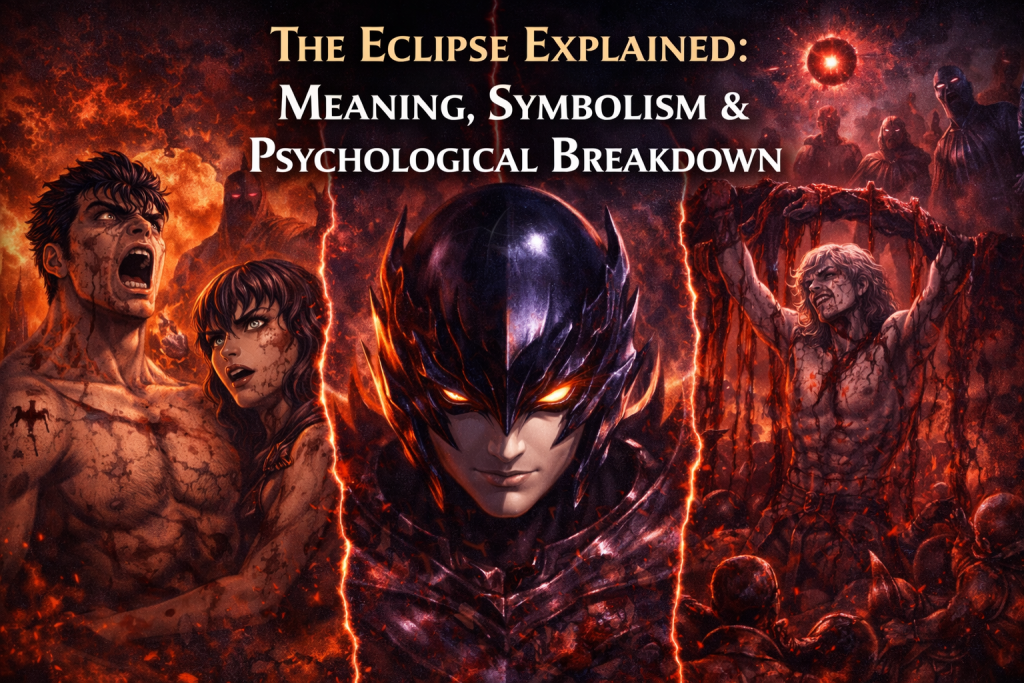


If there’s one moment in Berserk that changed manga history forever…
It’s the Eclipse.
It’s not just shocking.
It’s not just brutal.
It’s a philosophical explosion.
Let’s break it down slowly — not just what happened, but what it means.
1. What Is the Eclipse?
The Eclipse is a sacrificial ceremony triggered by a Behelit when its owner reaches absolute despair.
In this case, that owner is Griffith.
After a year of torture, broken physically and mentally, Griffith activates the Crimson Behelit.
The sky turns red.
Reality bends.
Time stops.
The Band of the Hawk is transported into a nightmare dimension.
And the God Hand descend.
They offer Griffith a choice:
Sacrifice everything
Or remain broken forever.
2. The Core Theme: Causality
One of the biggest ideas in Berserk is causality — the belief that events are pre-determined.
The God Hand explain that Griffith’s entire life led to this moment.
Every victory.
Every friendship.
Every betrayal.
It was always going to happen.
The Eclipse represents destiny closing its hand.
But here’s the twist:
Guts fights anyway.
Even when fate is declared absolute.
Even when it’s hopeless.
That rebellion is the heart of Berserk.
3. The Psychological Meaning
The Eclipse isn’t just supernatural horror.
It’s psychological collapse made physical.
Griffith faces his greatest fear:
Living powerless.
He sees a vision of a quiet life — dependent on Guts and Casca.
He rejects it.
Why?
Because his identity is built entirely on ambition.
Without his dream, he believes he is nothing.
So he sacrifices:
- His comrades
- His humanity
- His past self
The Eclipse symbolizes the moment ambition devours empathy.
4. The Brand of Sacrifice – What It Represents
When the Band of the Hawk are marked with the Brand of Sacrifice, it means:
They are offerings.
But symbolically?
It represents being abandoned by destiny.
The brand also marks Guts and Casca permanently.
They survive — but they are cursed.
This is important:
Griffith ascends by sacrificing others.
Guts survives by enduring sacrifice.
Two opposite paths.
5. Femto – The Birth of Something Inhuman

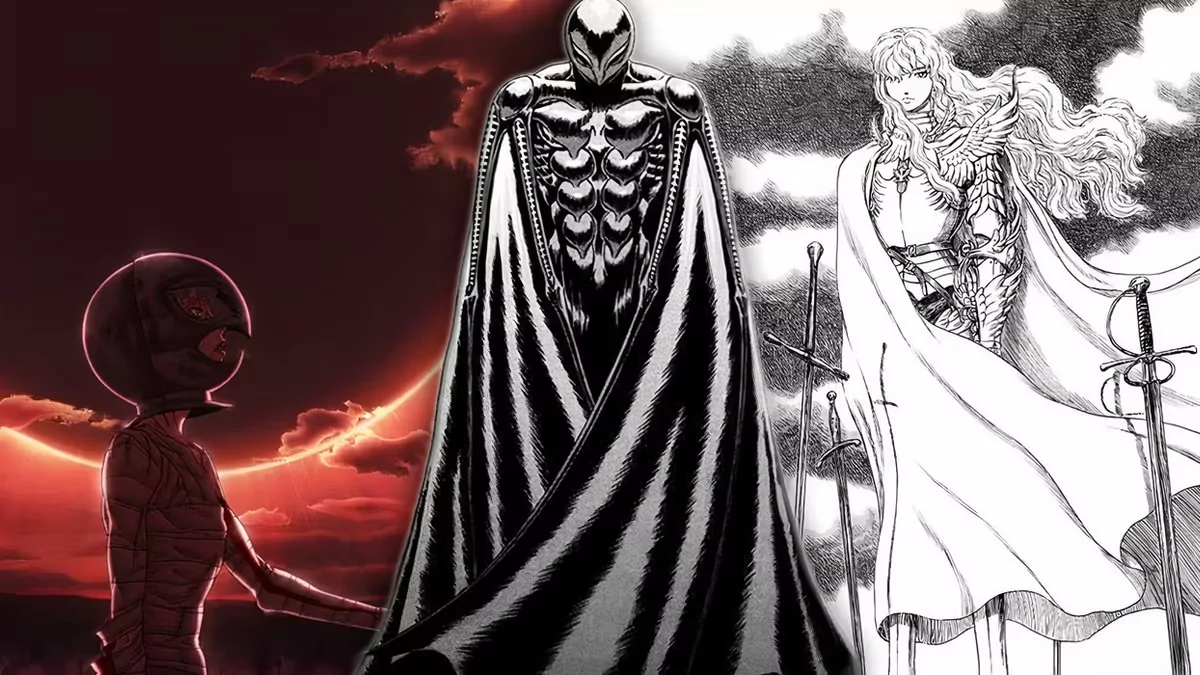

When Griffith transforms into Femto, something profound happens.
He loses visible emotion.
He becomes calm.
Cold.
Detached.
Femto isn’t rage.
Femto is indifference.
That’s scarier.
Because rage still implies humanity.
Indifference does not.
6. Why the Eclipse Feels So Traumatic to Readers
Most dark fantasy stories have brutal scenes.
But the Eclipse hits differently.
Because it destroys trust.
For years, readers grew attached to the Band of the Hawk.
We watched them grow.
Laugh.
Win battles.
Then, in one moment, everything is erased.
It mirrors real-life betrayal trauma.
That’s why it lingers.
7. The Scene That Broke the Fandom
The assault of Casca during the Eclipse is one of the most controversial moments in manga history.
It is not written for shock alone.
It represents:
- Total domination
- Psychological revenge
- The final severing of Griffith and Guts’ bond
It’s the point of no return.
After that moment, reconciliation becomes impossible.
8. The Eclipse as a Philosophical Statement
The Eclipse asks one brutal question:
How much are you willing to sacrifice for your dream?
Griffith answers:
Everything.
Guts answers:
Nothing worth losing humanity.
That’s the eternal conflict of Berserk.
Ambition vs Compassion.
Destiny vs Defiance.
9. Why It Changed Dark Fantasy Forever
Before Berserk, dark fantasy existed.
After the Eclipse, it evolved.
The influence of Kentaro Miura can be seen in:
- Dark Souls
- Attack on Titan
- Many modern grimdark stories
The Eclipse redefined what storytelling could risk.
It showed that even central characters aren’t safe.
Final Meaning of the Eclipse
The Eclipse isn’t just about demons.
It’s about choice.
Griffith chose ambition over humanity.
Guts chose struggle over surrender.
And the world of Berserk was reborn in blood.
That’s why the Eclipse isn’t just a scene.
It’s the soul of the entire story.