The Philosophy of Berserk: Destiny vs Free Will
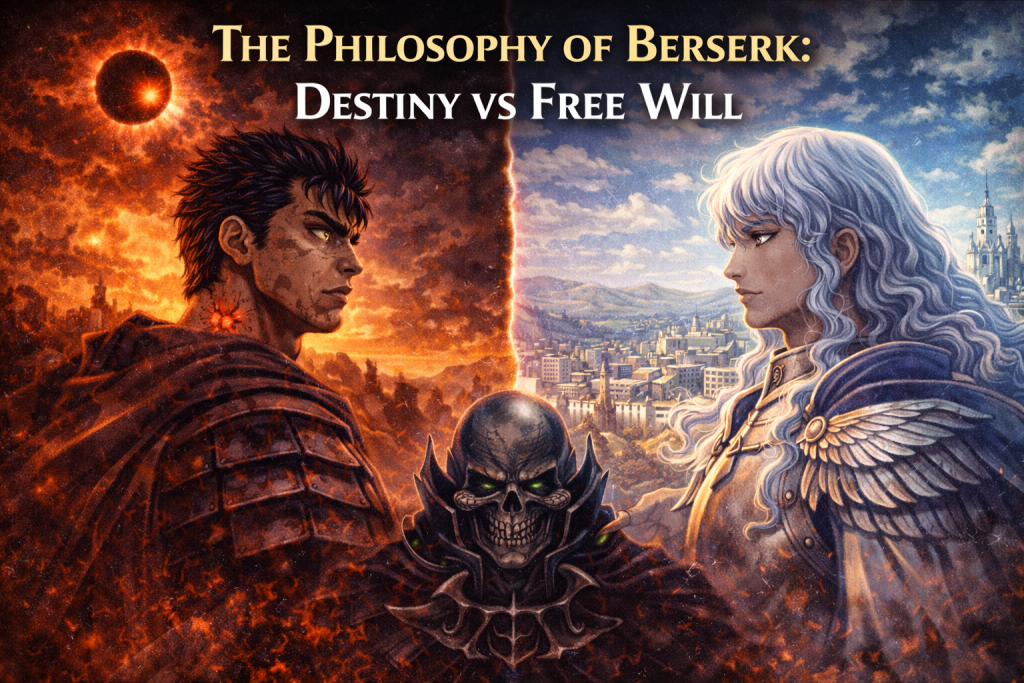


At its core, Berserk isn’t just about swords and demons.
It’s about a question humanity has asked for centuries:
Are we controlled by fate…
or do we choose our own path?
Let’s break this down properly.
1. Causality – The World of Fate
Throughout Berserk, the God Hand constantly mention one word:
Causality.
In their world, nothing is random.
Every tragedy.
Every meeting.
Every betrayal.
All pre-determined.
When Griffith activates the Behelit during the Eclipse, they tell him:
“You were always meant to stand here.”
That’s terrifying.
Because it suggests that the Band of the Hawk were always meant to die.
2. Griffith – The Man Who Accepts Destiny
Griffith represents acceptance of fate.
He believes he was born for greatness.
Even before becoming Femto, he acts like someone chosen.
When faced with despair, he doesn’t reject the cosmic design.
He embraces it.
He sacrifices everything to fulfill what he believes is his destined role.
In a way, Griffith wins because he stops resisting.
He aligns himself with fate.
3. Guts – The Man Who Rejects Fate


Now look at Guts.
He is branded as a sacrifice.
That means destiny says he should be dead.
But he survives.
Not because of prophecy.
Not because he’s chosen.
Because he refuses to die.
Guts doesn’t believe in destiny.
He believes in swinging his sword again tomorrow.
Even if fate says it’s pointless.
That defiance is the heart of Berserk.
4. The Skull Knight – A Warning From the Past
Skull Knight appears repeatedly to warn Guts.
He has witnessed multiple cycles of tragedy.
He speaks as if history repeats.
Almost like fate is a loop.
He suggests that those who fight causality often fall into it anyway.
Which raises a powerful possibility:
Maybe Guts isn’t escaping fate.
Maybe he’s walking exactly where fate expects him to.
5. The Brand of Sacrifice – Symbol of Destiny
The Brand marks someone chosen for death.
It attracts demons.
It never fades.
Symbolically, it represents:
You cannot escape what the universe has written.
But Guts and Casca live despite it.
So what does that mean?
Is fate imperfect?
Or is their suffering part of a larger design?
6. Falconia – The Illusion of Control
Griffith builds Falconia as a utopia.
Humans see him as a savior.
He protects them from monsters.
But here’s the irony:
He created the world that needs saving.
By merging the astral and physical realms, he reshaped reality itself.
Is he controlling fate?
Or fulfilling it?
That ambiguity is intentional.
7. Miura’s Hidden Message
The genius of Kentaro Miura is that he never gives a clear answer.
He doesn’t say fate is absolute.
He doesn’t say free will wins.
Instead, he shows something deeper:
Even if destiny exists…
Your response to it is yours.
Guts cannot erase the Eclipse.
He cannot undo trauma.
But he chooses to protect Casca.
He chooses to travel forward.
He chooses to care.
And that choice matters.
8. Why This Theme Feels So Personal
Berserk resonates deeply because everyone has felt trapped by circumstances.
Family.
Society.
Failure.
Loss.
Sometimes it feels like fate.
But Guts teaches something brutal yet inspiring:
Even if the world is cruel…
You can still choose how you respond.
You may not control events.
But you control your next step.
Final Thought
Destiny in Berserk may be powerful.
The God Hand may manipulate events.
Griffith may align with cosmic design.
But one scarred warrior keeps resisting.
And that resistance — even if it fails — is meaningful.
Because free will isn’t about winning.
It’s about refusing to surrender.